

What Is Rope Access? How It Works, Its Advantages, and Safety Standards
Rope access is the go-to method for cleaning glass, installing sealant, and inspecting high-rise facades. Learn how it works, why it is efficient, and which safety standards apply.
Published · Tim Inland
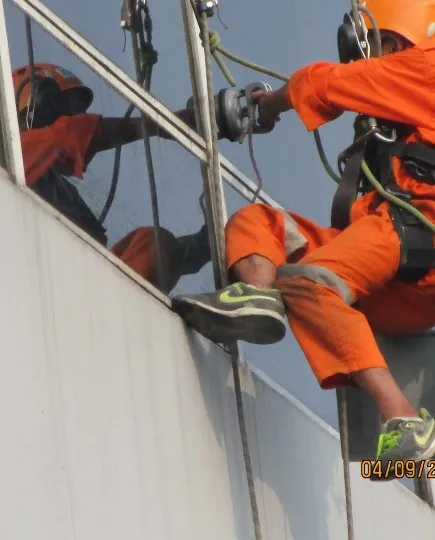
Table of Contents
Cleaning skyscraper glass, replacing sealant on the 20th floor, or inspecting a hard-to-reach facade—all of this is now routinely done with rope access. So what exactly is rope access, and why do building managers increasingly choose it?
What Is Rope Access?
Rope access is a method of working at height using a two-rope system: a working line that supports and moves the technician, and a backup/safety line that is always attached as a backup. Technicians move up, down, or sideways using specialist equipment such as a harness, descender, ascender, and fall-arrest devices.
How Rope Access Works
- Survey and planning: identify anchor points, work routes, and risks.
- Anchor installation: anchor points are fixed to strong structural elements on the roof.
- Equipment inspection: every item is checked before use.
- Execution: technicians descend in stages while working on each area.
- Supervision: a supervisor monitors safety and work quality.
Rope Access vs Scaffolding and Gondolas
| Aspect | Rope access | Scaffolding | Gondola |
|---|---|---|---|
| Set-up time | Fast | Long (assembly and dismantling) | Moderate |
| Cost | Usually more efficient | High for tall buildings | High if not already installed |
| Access to complex facades | Very flexible | Limited | Limited to the rail track |
| Disruption to building activity | Minimal | Significant | Moderate |
Work Done with Rope Access
- Building glass cleaning and exterior walls.
- Installing and repairing building glass sealant.
- Painting and repairing facades, ACP cladding, or panels.
- Visual inspection of facades and structures.
Rope Access Safety Standards in Indonesia
In Indonesia, work at height is regulated by Minister of Manpower Regulation No. 9 of 2016 on Occupational Safety and Health for Work at Height. It covers worker competency, planning, work procedures, and equipment. Internationally, associations such as IRATA issue rope access technician certifications that are widely recognised by the industry.
Key rope access safety principles:
- Always use two independent ropes.
- Equipment is inspected and meets standards.
- Technicians are trained and work in teams, never alone.
- A rescue plan is in place before work begins.
Main Rope Access Equipment
- Full body harness to support the technician.
- Two kernmantle ropes (working and safety lines) meeting the required specification.
- Descender for a controlled descent.
- Ascender for climbing up the rope.
- Back-up device / rope grab on the safety line that locks automatically in a fall.
- Anchors and slings fixed to strong structures on the roof.
- Helmet, gloves, and other personal protective equipment.
All equipment must be checked before use and replaced when it shows signs of wear.
Rope Access Myths and Facts
“Rope access is more dangerous than a gondola.” Not necessarily. With two independent ropes, proper procedures, and trained technicians, rope access is designed so that a single equipment failure does not cause a fall.
“Rope access is only for cleaning glass.” In fact, it is used for inspection, painting, sealant repair, signage installation, and structural maintenance at height.
“Rope access disrupts building operations.” Quite the opposite: because it needs no large structure around the building, lobbies and car parks can usually stay in use, with a safety zone set up below the work area.
What to Check When Choosing a Rope Access Provider
- Evidence of technician competency or certification for work at height.
- A written work plan and rescue plan.
- Condition and completeness of equipment.
- Insurance or worker safety cover.
- Experience with similar buildings.
When Does Your Building Need Rope Access?
Rope access is ideal for offices, apartments, hotels, and commercial buildings without a gondola, or with complex facade shapes. For cost estimates, read building window cleaning cost per m².
Inland provides rope access services for glass cleaning, sealant, and facade maintenance across Greater Jakarta. Contact us for a survey and quote.
Read also: Building window cleaning cost · Why building glass leaks · Related service: building maintenance.
Related Articles
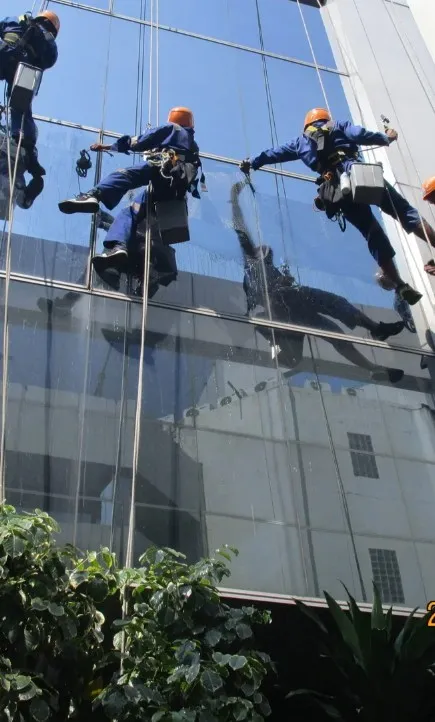
Building Window Cleaning Cost per m² in 2026 and How Often to Clean
How much does it cost to clean a building's glass, and how often should it be done? See 2026 per-m² market ranges in Greater Jakarta, the factors behind the price, and tips for choosing a provider.
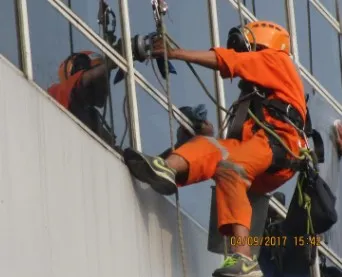
Why Building Glass Leaks: 5 Common Causes and How to Fix Them
Water stains on inside walls or wet carpet by the windows every time it rains? Learn the five most common causes of leaking building glass, the warning signs, and how proper re-sealing fixes them.
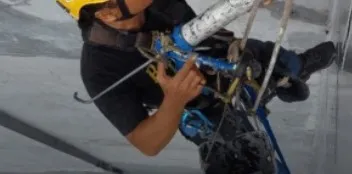
Professional High-Rise Glass Sealant Services by Inland
Professional repair and installation of high-rise glass sealant using rope access, protecting your building from leaks and extreme weather.