

How to Choose a Reliable Home Contractor: 10 Things to Check
Don't let your home project stall halfway. Here are 10 things to check before hiring a contractor, from portfolio and cost estimate to the contract and progress-based payments.
Published · Tim Inland
Table of Contents
- 1. Portfolio and completed projects
- 2. References from previous clients
- 3. Legal standing and a real office address
- 4. A site survey before quoting
- 5. An itemised cost estimate
- 6. Clear working drawings
- 7. A written contract before money changes hands
- 8. Progress-based payment stages
- 9. Warranty and responsibility after handover
- 10. Communication and progress reports
- Red Flags to Avoid
- Questions to Ask a Contractor
- Contractor, Foreman, or Day Labourers?
- Comparing Quotes Fairly
- Choose a Transparent Contractor
Choosing a contractor is the most important decision when building or renovating a home. The right contractor keeps the project on track; the wrong one can blow the budget, deliver poor quality, or leave the project unfinished. Here are 10 things to check before hiring a home contractor.
1. Portfolio and completed projects
Ask for examples of similar projects—houses, renovations, or added storeys—with before-and-after photos. If possible, visit a project that is under way.
2. References from previous clients
Ask past clients directly: was the project finished on time and on budget, and how did the contractor handle problems?
3. Legal standing and a real office address
A contractor with a registered business, an office address, and clear contact details is easier to hold accountable. Construction competency certificates are a plus. For construction companies, certification status can be checked through the LPJK at the Ministry of Public Works, in line with Law No. 2 of 2017 on Construction Services.
4. A site survey before quoting
A serious contractor surveys the site first. A price given without seeing the location is usually inaccurate and leads to extra charges.
5. An itemised cost estimate
The RAB (itemised cost estimate) should list quantities, material specifications, and unit prices. With a detailed estimate, you can compare quotes fairly and check materials on site—for example the size of reinforcing bars.
6. Clear working drawings
Correct work is work that matches the drawings and cost estimate. Make sure architectural and structural drawings exist before work begins.
7. A written contract before money changes hands
At minimum, the contract should cover scope of work, schedule, contract value and payment stages, material specifications, rules for variations, warranty, and penalties for delays.
8. Progress-based payment stages
Avoid paying most of the money upfront. Paying per progress stage lets you inspect the work before paying for the next stage.
9. Warranty and responsibility after handover
Ask whether there is a maintenance or warranty period for leaks, cracks, or defects after the house is finished.
10. Communication and progress reports
A good contractor reports regularly—progress photos, schedule, and issues—and responds quickly to questions.
Red Flags to Avoid
- Asking for a large upfront payment without clear progress.
- Refusing to provide a detailed cost estimate or written contract.
- Prices far below market without explaining the specification.
- A portfolio that can’t be verified.
Questions to Ask a Contractor
Use this list at the first meeting to gauge how serious and experienced the contractor is:
- How long have you handled similar projects, and can I see examples?
- Who will supervise my project on site every day?
- Does the price include materials, labour, debris removal, and clean-up?
- What happens if work is added or removed during the project?
- How do the payment stages work, and what is required for each?
- How long is the maintenance period after handover, and what does it cover?
- How will you report progress—daily photos, weekly reports, or joint site visits?
Contractor, Foreman, or Day Labourers?
| Option | Advantages | Risks |
|---|---|---|
| Contractor | One party is responsible for technical design, cost estimate, schedule, and results | Management cost is included in the price |
| Lump-sum foreman (mandor) | Price can be lower | Supervision and material purchasing often fall on the owner |
| Day labourers | Flexible for small jobs | Costs are hard to predict; the owner must supervise fully |
For larger projects such as building a house or adding a storey, a contractor with a clear cost estimate and contract is usually safer because technical responsibility sits with one party.
Comparing Quotes Fairly
Don’t compare only the total price. First align the scope of work and material specifications—for example concrete grade, rebar size, roof structure type, and tile brand. Two quotes with a big price gap are often not pricing the same work.
Choose a Transparent Contractor
As a contractor in Greater Jakarta, Inland works with site surveys, itemised cost estimates, written contracts, and regular progress reports—for both house construction and house renovation. Contact us for a free consultation.
Read also: House construction cost per square meter · House renovation cost per square meter
Related Articles
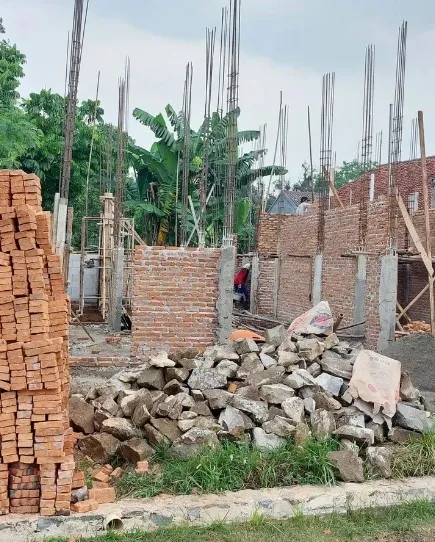
House Construction Budget (RAB): What It Includes and How to Prepare One
A RAB is the key to keeping a build or renovation budget under control. Learn what goes into it, how to prepare one step by step, and the most common mistakes.
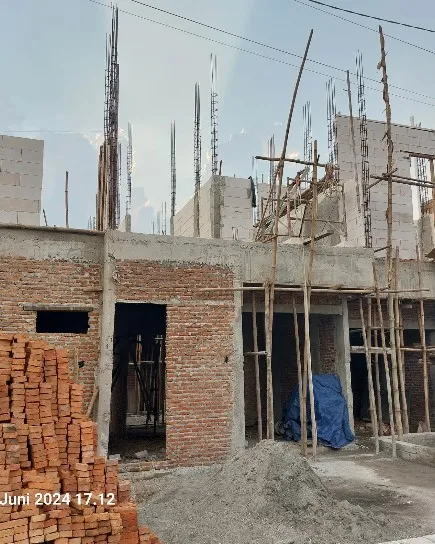
House Construction Cost in 2026: Type 36, 45, and 70 Homes per Square Meter
Sample 2026 construction budgets for type 36, 45, and 70 homes based on per-m² market ranges in Greater Jakarta, including the cost items that are often overlooked.

PBG, the Building Approval That Replaced the IMB in Indonesia: Requirements and Process
Since 2021, Indonesia's IMB building permit has been replaced by the PBG. Learn when a house needs a PBG, which documents are required, how to apply online through SIMBG, and what changes for existing homes.